

Adult Social Care Nursing Workforce Development Project

Aims
This project is a joint venture between the Buckinghamshire Health and Social Care Academy (BHSCA), Buckinghamshire New University (BNU), and the Royal Society of Public Health (RSPH) to support the social care agenda in Buckinghamshire.
The project's principal aim is to understand adult social care nursing workforce training and development needs and provision, and identify barriers, particularly entry-level early career requirements.
The project seeks to co-create, based on the evidence, a gateway that enables the provision of innovative and integrated education, training, knowledge transfer and organisational/professional development for the adult social care workforce.
Workstreams
The project consists of 4 workstreams.
- Workstream 1: An initial brief literature scope using grey literature and peer-reviewed papers publicly available from England and the UK to understand the current situation in adult social care (ASC). (Timeline: January - May 2025 - COMPLETED)
- Workstream 2: A qualitative exploration of practitioners’ voices in Buckinghamshire. This work stream will gather insight into the experiences of entry-level adult social care staff and managers of care facilities and care organisations using interviews and focus groups. (Timeline: March - June 2025 - COMPLETED)
- Workstream 3: A series of workshops will be conducted with an invited group of expert stakeholders in Adult Social Care in Buckinghamshire to discuss the key skills needed and the career pathways for adult social care workers. (Timeline: March - November 2025 - COMPLETED)
- Workstream 4: A pilot training programme developed and presented by the Royal Society of Public Health (RSPH) for adult social care workers, carers and volunteers.
(Timeline: Cohort 1 in May 2025; Cohort 2 in September 2025 and Cohort 3 in October 2025 (e-learning only) complete)
Adult Social Care Nursing Workforce Development Event Showcase Event | November 2025
Celebrating Progress in Adult Social Care Nursing Workforce Development
Buckinghamshire New University hosted a special event celebrating the progress and impact of the Adult Social Care Nursing Workforce Development Project—a collaborative initiative funded by the Burdett Nursing Trust and delivered in partnership by the Buckinghamshire Health and Social Care Academy (BHSCA), Buckinghamshire New University (BNU), and the Royal Society for Public Health (RSPH).
The project’s core aim is to better understand the training and development needs of the adult social care nursing workforce, with a particular focus on entry-level and early career pathways, and to identify barriers to progression.
The event opened with a welcome from Professor David Sines CBE, Trustee of the Burdett Nursing Trust, and featured:
- Presentation of new research findings (see below)
- Launch of co-designed workforce development resources
- Introduction of a new early career education pathway
- Opportunities for networking and collaboration across the sector
This gathering provided a valuable opportunity to build on the project’s achievements and explore how to collectively advance its goals—delivering innovative, integrated education and training, and strengthening knowledge-sharing across the adult social care workforce in Buckinghamshire.
Participants from across nursing and adult social care came together to discuss the practical application of the project’s recommendations and identify opportunities for collaborative action to support workforce development.
For press enquiries, please contact:
📧 adultcareproject@bucks.ac.uk
📧 bht.bhsca-info@nhs.net



Project Resources and Toolkits
Check back soon as resources will be added as the project progresses
- Buckinghamshire Council Better Lives Strategy
- Project Literature Review booklet
- The Practitioner's Voices report
- Expert Reference Group booklet
- RSPH pilot training programme evaluation report
- Project bookmark
- Project Infographics - Expert Reference Group | Literature Scope | Practitioners Voices
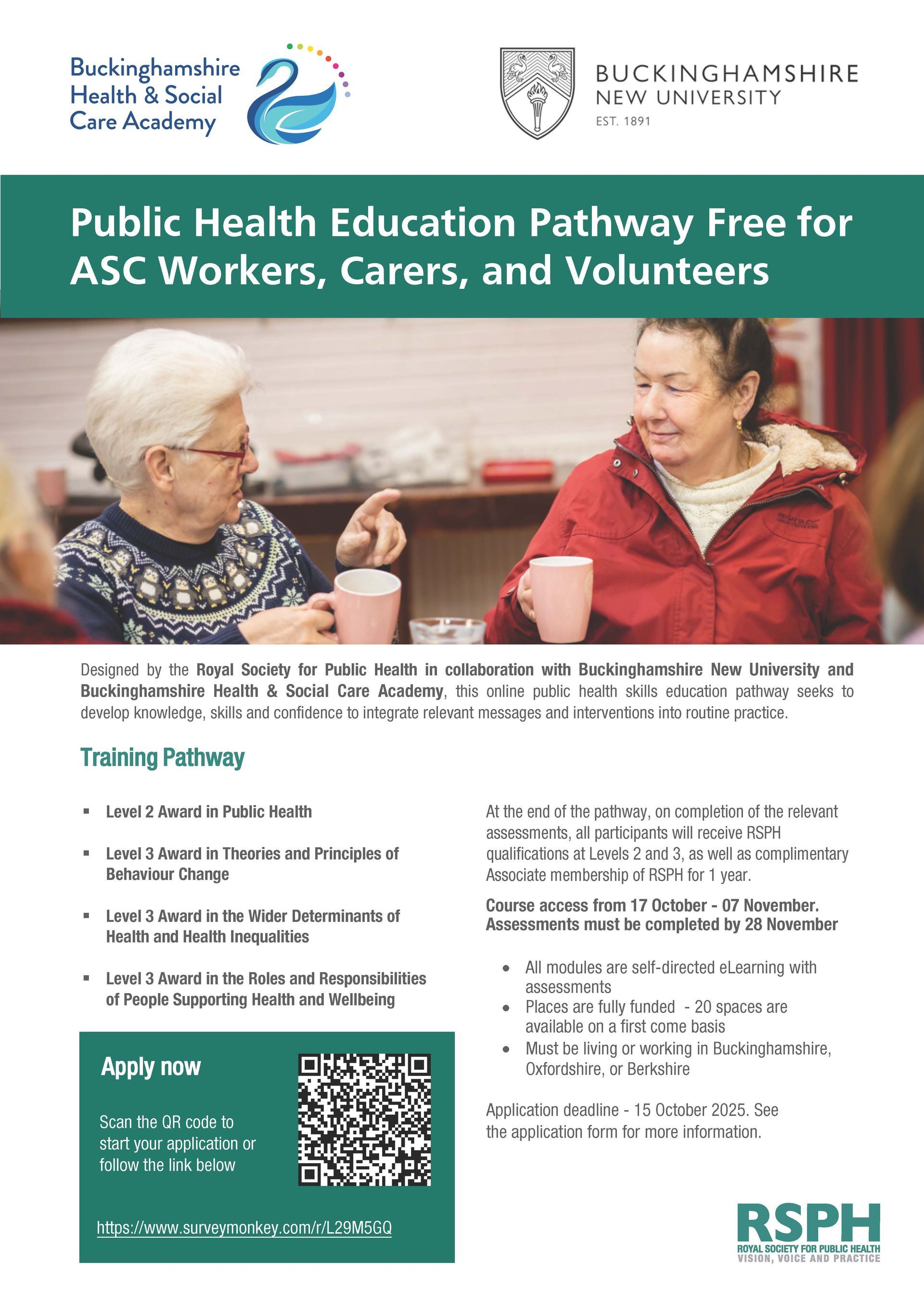
- ASCW Pathway training flyers - Cohort 1 | Cohort 2 | Cohort 3
- Participation Recruitment flyer - 'Your Views Needed'
- Participant Recruitment - Online Survey Poster
- Project posters - Expert Reference Group | Literature Scope | Practitioners Voices
- Overall Summary report

This project is supported by funding from The Burdett Trust